Creative LEGO Build Prompts: Build Beyond the Box
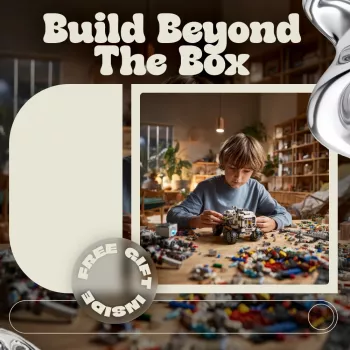
Build Beyond the Box: Creative LEGO Prompts That Turn Any Brick Pile Into Fresh Builds
Some days the instructions are fun. Other days, the best builds happen after the last bag is empty—when the pieces are mixed, the rules are loose, and the only goal is to make something new. Build Beyond the Box is a creative ideas checklist designed to nudge kids, teens, and adults past “what should I build?” and into “what could I build?” with quick prompts, playful constraints, and repeatable challenges that work with any LEGO collection.
Play-based building supports skills that matter well beyond the bricks—like experimenting, revising, and explaining ideas. If you want a deeper read on why open-ended play is powerful, you can explore LEGO Education’s learning-through-play resources, the American Academy of Pediatrics’ overview on the power of play, and the OECD’s work on creative thinking.
What “Build Beyond the Box” Helps Unlock
- A simple start when motivation is low: you choose a prompt and begin with the bricks already on hand—no sorting marathon required.
- More original builds from the same sets: prompts push you to remix, combine, and reimagine parts instead of defaulting to “I need more pieces.”
- Better creative stamina: short, repeatable challenges help you practice generating ideas without waiting for the “perfect” plan.
- A shared activity across ages: the same prompt can be a 10-minute warm-up for a kid or a 60-minute design problem for an adult—ideal for families, clubs, and classrooms.
How to Use the Checklist (Fast, Flexible, No Special Setup)
- Pick a timebox: 10 minutes (warm-up), 30 minutes (main build), or 60 minutes (challenge mode).
- Choose one prompt, then add one constraint: limit colors, limit piece count, or build only with a specific element type (tiles, slopes, hinges).
- Start with a “seed” piece: pick one interesting element and make it the anchor (a windshield becomes a canopy, a wedge becomes a fin).
- Finish with a micro-reflection: name the build, describe its purpose, and choose one upgrade for next time (feature, stability, or story).
If you’re building with younger kids, your timebox is the secret weapon. A short timer turns “clean up your room of bricks” into “finish a mission.”
Prompt Types That Keep Builds Feeling New
- Theme prompts: build a habitat, vehicle, gadget, creature, or city detail—with a twist (tiny scale, oversized scale, or “future version”).
- Mechanic prompts: include a moving part (hinge, slider, spinning element, pull-back idea) even if it’s simple.
- Story prompts: create a scene with a problem, a helper, and a surprising tool—then build the tool as a separate mini-model.
- Style prompts: build in one color family, build symmetrical, build “chunky,” or build with visible studs vs. smooth tiles.
- Remix prompts: rebuild a familiar model as a different category (car → submarine, house → space station, robot → animal).
Build Challenges for Kids, Teens, and Adults (Same Bricks, Different Levels)
For kids
Keep it short and concrete. Instead of “build a castle,” try “build a door that opens” or “build a bridge that holds a minifig.” One clear feature keeps frustration low and finishing rates high.
For teens
Add design goals: two functions, a transformation, or a build that fits into a larger display (street corner, hangar bay, arena). Constraints make the build feel like a puzzle instead of “random free-build.”
For adults
Focus on technique and iteration. Build three versions of the same idea (v1 blocky, v2 refined, v3 your “signature style”). Iterating on one concept teaches more than starting over every time.
For mixed-age groups
If you feel stuck
A 7-Day “Beyond the Box” Mini Plan
| Day | Prompt | Constraint | Finish line |
|---|---|---|---|
| 1 | Build a tiny vehicle | Max 25 pieces | Must roll or “look fast” |
| 2 | Build a creature | Only 2 colors | Give it a signature feature (horn, wing, tail) |
| 3 | Build a room corner | Include one window/arch | Add 3 story objects (tool, food, clue) |
| 4 | Build a gadget | Use at least 1 hinge | Must open/reveal something |
| 5 | Remix a classic build | Change the theme (pirate→space) | Keep one recognizable silhouette detail |
| 6 | Build a micro-landscape | Mostly slopes/tiles | Include a path or river line |
| 7 | Build a “boss level” model | Combine 2 earlier builds | Add one new function or scene connection |
Make It a Game: Simple Scoring That Encourages Experimenting
When to Pull Out the Checklist (Best Moments to Use It)
Product Picks From Our Team
- Build Beyond the Box – LEGO Building Creative Ideas Checklist for Kids, Teens & Adults | Creative LEGO Build Prompts & Imagination Guide ($5.99): our go-to option when you want fast starts, repeatable challenges, and a clear way to turn “random bricks” into a fresh build session.
- premium-leather-strap-for-apple-watch-49mm-45mm-44mm-41mm-40mm ($4.97): a simple comfort upgrade if you wear your watch while building and want a different feel on your wrist during longer sessions.
FAQ
Is this better for kids, teens, or adults?
It’s designed to work across ages because you scale the same idea with timeboxes and constraints. Kids can focus on one clear feature, teens can add functions and display goals, and adults can iterate versions and refine technique—while everyone builds from the same prompt.
Do you need a big LEGO collection for the prompts to work?
No—these challenges work with any assortment because you can constrain piece count, colors, or element types. Smaller collections often do better with micro-builds (tiny vehicles, room corners, gadgets) where finishing is quick and satisfying.
How do you keep prompts from feeling repetitive?
Mix one prompt with a new constraint and a different timebox, then try a quick v1/v2/v3 iteration. Swapping themes (pirate to space) or combining two prompts into one build also makes the same starting idea feel brand new.











Leave a comment