Guided Journaling for Emotional Clarity, Mindfulness & Ideas

A Gentle Path to Emotional Clarity: Journaling for Self-Discovery, Creativity, and Mindfulness
Journaling can be more than recording events—it can become a steady practice for naming emotions, noticing patterns, and making room for new ideas. With the right structure, a few minutes a day can support calmer decision-making, deeper self-understanding, and a more mindful relationship with everyday life. Research also suggests that writing about emotions can support stress relief and overall wellbeing when done consistently and safely (Harvard Health Publishing; American Psychological Association).
What changes when journaling is guided
Guided journaling shifts the practice from “staring at a blank page” to “following a gentle path.” Instead of waiting for motivation or the perfect insight, you start with a question and let the answer meet you where you are.
- Reduces blank-page pressure by offering a starting point, so the practice feels approachable even on low-energy days.
- Creates repeatable routines (check-ins, reflections, gratitude, future planning) that build emotional awareness over time.
- Helps separate facts from feelings, making it easier to respond intentionally instead of reacting automatically.
- Encourages gentle self-honesty through specific questions that reveal needs, values, and boundaries.
Over time, those small, structured moments can make your inner world feel less like a swirl and more like a set of understandable signals.
Emotional clarity: turning “I feel off” into understandable signals
Emotional clarity isn’t about forcing positivity. It’s about translating “something’s wrong” into information you can work with. A few simple formats keep the focus practical and repeatable.
- Daily emotional check-in: name the emotion, rate intensity (1–10), and identify the most likely trigger.
- Body scan notes: record where stress shows up physically (jaw, chest, stomach) to spot early cues.
- Needs-based reflection: link emotions to unmet needs (rest, connection, autonomy, safety, meaning).
- Repair and reassurance: write one supportive sentence that acknowledges the feeling without judgment.
Simple entries that build emotional clarity
| Practice | Time | What to write | Outcome to look for |
|---|---|---|---|
| One-word mood + why | 2 minutes | Emotion label and one reason it may be present | Less confusion, more precision |
| Trigger map | 5 minutes | Event → thought → feeling → response | Pattern recognition |
| Need finder | 5 minutes | “If this feeling could talk, it would ask for…” | Clear next step |
| Self-soothing script | 3 minutes | A compassionate message to the current version of yourself | Reduced intensity |
Self-discovery: uncovering values, patterns, and boundaries
Once emotions feel more legible, self-discovery becomes less abstract. The page turns into a mirror you can actually use: not to judge yourself, but to notice what’s true and what you want to protect.
- Values spotlight: identify your top 3 values this week and note where actions matched or drifted from them.
- Pattern audit: track recurring themes (overcommitting, conflict avoidance, perfectionism) without blame.
- Boundary clarity: write what is okay, what is not okay, and what consequence protects your wellbeing.
- Identity expansion: explore roles beyond productivity (friend, learner, creator, helper, adventurer).
For boundary clarity, a helpful template is: “It’s okay when… It’s not okay when… If it continues, I will…” This keeps the boundary focused on your actions and limits rather than controlling someone else’s behavior.
Creativity: using the page to generate ideas, not just summarize life
Creativity often gets blocked by pressure—especially the pressure to “make it good.” A journal can be an idea lab where rough drafts are welcome, and where curiosity matters more than polish.
- Idea composting: capture fragments (images, phrases, questions) and revisit weekly to combine them.
- Constraint creativity: write for 7 minutes using a single theme (water, doors, light, seasons) to loosen perfectionism.
- Perspective shift: rewrite a situation from the viewpoint of a future self, mentor figure, or calm observer.
- Playful lists: “10 tiny experiments to try,” “5 things I’m curious about,” “3 ways to make today gentler.”
When creativity feels stuck, aim for volume, not verdicts. A page of “bad” ideas is often the fastest route to one that’s surprisingly useful.
Mindfulness: turning journaling into a grounding practice
Mindfulness doesn’t require long sessions. It’s the simple skill of noticing what’s happening now—without immediately fighting it. Journaling can anchor that noticing in language, which makes it easier to return to later. For a helpful overview of mindfulness basics, see University of Rochester Medical Center.
A sustainable routine: small sessions that actually stick
Using a digital guide without losing the personal feel
A guided companion for daily reflection
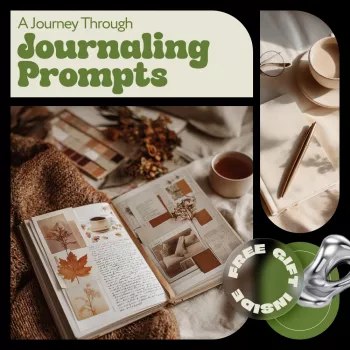
If structured questions make journaling feel more doable, a themed digital guide can keep you moving without overthinking. A Journey Through Journaling Prompts | Emotional Clarity, Self-Discovery, Creativity & Mindfulness Digital Guide is designed for quick daily check-ins, deeper weekly reflections, and long-term pattern awareness—useful for beginners who want direction and experienced journalers who want fresh angles.
To support a consistent routine, helpful add-ons can be simple: a comfortable everyday band for quick reminder checks like the Corduroy Fabric Strap for Apple Watch, or a dressier option like the milanese-magnetic-stainless-steel-band-for-apple-watch if you prefer a more polished look for workdays.
FAQ
How long should a journaling session be to feel helpful?
Two to fifteen minutes is a realistic range for most schedules. Consistency matters more than length, so keep a “minimum entry” option (like three sentences) for busy or low-energy days.
What if journaling brings up difficult emotions?
Pause and ground yourself with slow breathing, then write with compassion rather than criticism. If you feel overwhelmed or stuck in distress, it can help to step away and consider support from a qualified mental health professional.
Is digital journaling as effective as writing by hand?
Yes—effectiveness depends more on comfort and consistency than on the medium. Digital journaling can be easier to organize and search, and it works well when paired with clear privacy practices like locked notes or secure folders.














Leave a comment