Think Clearer: Critical Thinking eBook With Brain Teasers
Smarter Decisions Start With Clearer Thinking
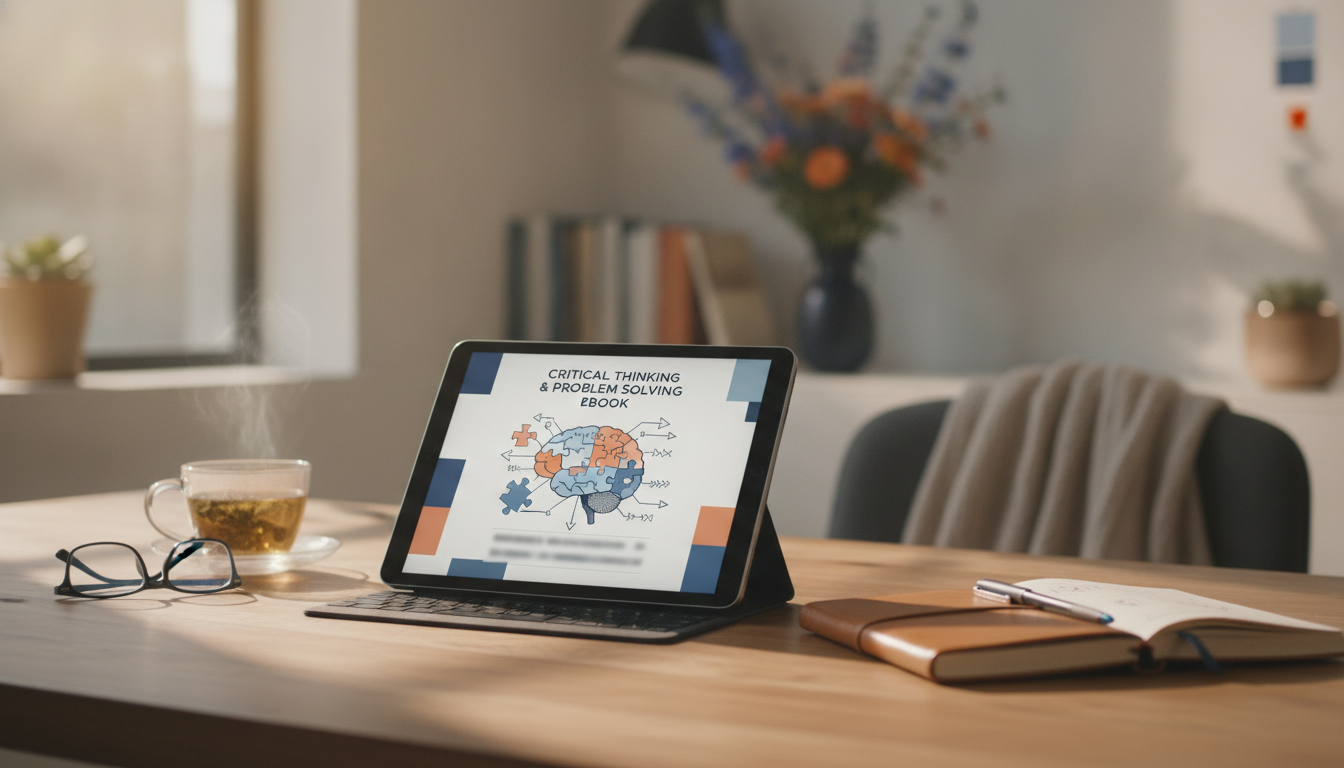
Better decisions rarely come from “more information” alone—they come from clearer thinking. The Critical Thinking & Problem Solving eBook – Digital Download Guide for Smarter Decision Making, Brain Teasers & Life Skills Ebook is built around practical habits that translate into everyday wins: spotting weak arguments, breaking down messy situations, choosing between options with confidence, and training the mind through brain teasers that build flexible reasoning.
Instead of treating critical thinking like an academic subject, this guide treats it like a repeatable skill. With quick frameworks, real-life scenarios, and puzzles that sharpen attention and logic, it helps turn “I’m not sure” into “Here’s what I know, what I’m assuming, and what I’ll do next.”
What “critical thinking” looks like in real life
Critical thinking shows up in ordinary moments—especially when the stakes feel high and the situation feels unclear. It can look like:
- Turning big, stressful problems into smaller parts that can be solved in sequence
- Separating facts, assumptions, and opinions before taking action
- Recognizing common reasoning traps (jumping to conclusions, confirmation bias, sunk-cost thinking)
- Asking better questions to clarify goals, constraints, and trade-offs
- Using simple frameworks to decide faster without oversimplifying
At its core, critical thinking is purposeful, self-correcting judgment. Helpful references include the APA Dictionary definition of critical thinking and the broader overview in the Stanford Encyclopedia of Philosophy entry on Critical Thinking, both of which emphasize evaluating reasons and improving decisions through better reasoning habits.
What’s included in the digital download guide
This eBook focuses on tools that are easy to practice and useful under real-world pressure. Inside, you’ll find:
- Decision-making tools that help compare options using criteria that matter (time, cost, risk, values, impact)
- Problem-solving steps for complex situations: define the problem, diagnose causes, generate options, test, and refine
- Brain teasers designed to strengthen pattern recognition, logic, and creative approaches to constraints
- Life-skills applications: work scenarios, personal goals, communication, and everyday judgment calls
- A format meant for quick practice sessions or deeper skill-building over time
Skills the guide helps strengthen (and how they show up day to day)
| Skill | What it helps with | Everyday example |
|---|---|---|
| Clarifying the problem | Avoids solving the wrong issue | Identifying whether a “time problem” is actually a planning or prioritization problem |
| Logic and reasoning | Improves argument quality and reduces errors | Evaluating advice before following it |
| Option generation | Creates more paths to success | Finding alternatives when budget or time is limited |
| Risk awareness | Anticipates downsides before committing | Choosing between two purchases based on long-term value and hidden costs |
| Reflection and learning | Improves future decisions | Reviewing what worked after a tough conversation and adjusting next time |
How brain teasers support smarter decision-making
Brain teasers aren’t just “fun extras.” They train the same mental moves that improve everyday judgment—especially when information is incomplete or the path forward isn’t obvious. Consistent puzzle practice can help by:
- Building comfort with uncertainty and incomplete information
- Improving mental flexibility: switching strategies when the first approach fails
- Strengthening attention to detail and careful reading of constraints
- Encouraging structured experimentation rather than guessing
- Making practice engaging so skill-building stays consistent
That kind of flexible thinking also aligns with broader skills often discussed in education and assessment contexts, including creative problem approaches (see the OECD’s PISA 2022 Creative Thinking overview for related skill framing).
Practical frameworks to apply immediately
When a decision feels urgent, it’s easy to default to impulse or overthinking. The guide emphasizes lightweight frameworks that create structure quickly:
- The “goal–constraints–options” approach: define what success looks like, what limits exist, and what moves are available.
- The “assumption check”: list what must be true for a plan to work, then validate the riskiest assumptions first.
- The “trade-off grid”: score choices by 3–5 criteria to avoid impulsive decisions.
- Second-order thinking: consider consequences beyond the first result (time, relationships, maintenance, opportunity cost).
- Pre-mortem thinking: imagine the decision failed and list likely reasons, then reduce those risks.
Used regularly, these tools help turn vague stress into a clear next step: what to check, what to compare, and what to do first.
Who benefits most from this eBook
Digital download tips: getting the most value from the guide
If it helps to stay consistent, pairing practice with a daily timer or habit cue can make a difference. For people who like building routines around wearable reminders, accessories like the Corduroy Fabric Strap for Apple Watch or the milanese-magnetic-stainless-steel-band-for-apple-watch can make it easier to keep “10 minutes of thinking practice” as a regular block on your calendar.
Recommended picks
- Critical Thinking & Problem Solving eBook – Digital Download Guide for Smarter Decision Making, Brain Teasers & Life Skills Ebook (Digital Download)
- premium-leather-strap-for-apple-watch-49mm-45mm-44mm-41mm-40mm
FAQ
Is this eBook suitable for beginners with no background in logic or formal reasoning?
Yes. It’s designed for practical everyday use, starts with accessible concepts, and builds skill through examples, frameworks, and exercises rather than formal proofs or technical jargon.
How long does it take to see improvement in decision-making?
Many people notice more clarity within a few days of using the frameworks on real choices, while steadier consistency typically takes a few weeks. Short, regular practice—plus applying the tools to everyday decisions—makes the biggest difference.
Can the brain teasers help with work and study performance?
They can. Brain teasers strengthen focus, structured thinking, pattern recognition, and persistence, and the guide connects those puzzle skills to real situations so the practice carries over into work tasks and academic problem-solving.















Leave a comment